Beach Jernigan
The TommyknockersBeach Jernigan, the short-order cook at the Haven Lunch, becomes one of the most zealous defenders of Haven’s transformation. His story joins the ordinary work of feeding a small town to the escalating violence used to protect its secrecy: Beach can quietly remove a dangerous machine from a neighbor’s property, yet later helps make outsiders disappear and dies fighting against an attempted escape.
Identity and Life in Haven
Beach runs the Haven Lunch, a marginally profitable business that he owns outright. He works twelve hours a day at the grill to clear about sixty-five dollars a week, a narrow livelihood that leaves little room for interruption during the summer season. The restaurant is more than a workplace in his story: it is where he serves the town, watches its residents, and later encounters the outsiders whose presence threatens the order he has embraced.
When Ruth McCausland walks through Haven on a summer evening, Beach raises a hand to greet her, and she waves back. The exchange belongs to a scene that first looks reassuringly routine: neighbors recognize one another, townspeople gather at the counter, and the clock stands at 7:15. But the familiar gestures conceal a community already altered. Ruth notices empty gaps where teeth had been, and the apparent normality of the street gives way to the recognition that nothing is normal.
Beach’s everyday responsibilities also include watching over the consequences of the town’s transformation. During a long hot spell, the streets grow quiet, and Bobbi Anderson’s rebuilt digging truck can be heard in Haven Village. People know that something important is happening at the old Frank Garrick place, but do not talk about it openly. In this setting, silence is not the same as ignorance: the town senses the importance of the work even as its residents avoid naming what it means.
Practical Intervention and Growing Zeal
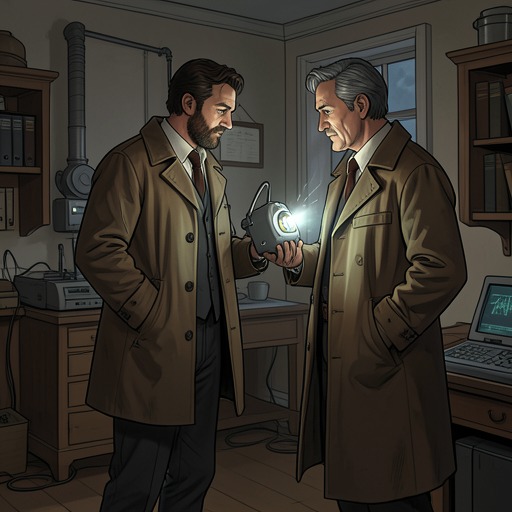
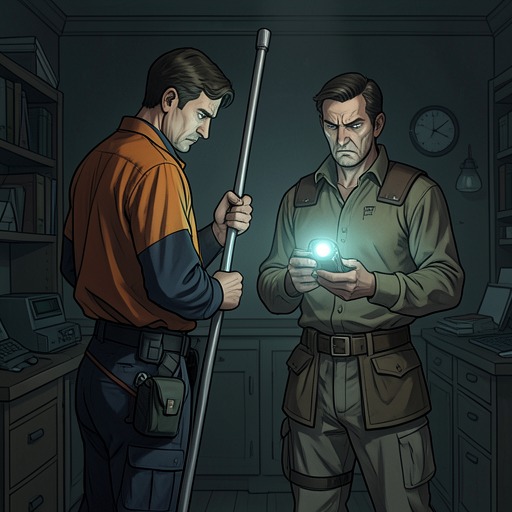
Beach takes direct action when Justin Hurd’s “becoming” leads him to build a machine capable of producing harmonic waves in the earth’s crust. Justin intends to shake rabbits and woodchucks from their burrows because they are eating his lettuces, but the machine could trigger an earthquake powerful enough to tear Maine open and send its eastern half sliding into the Atlantic. While Justin is out working his fields, Beach goes to his place and dismantles the device, which is assembled from scavenged stereo components. The intervention is practical rather than abstract: he removes a specific danger, while anticipating that Justin may rebuild it and that someone may have to dismantle it again.
That willingness to limit one dangerous consequence does not make Beach a critic of the transformation itself. He is described as more delighted by the “becoming” than anyone in Haven, and his partisanship is extreme even among townspeople for whom quiet zealotry is becoming a way of life. He would have supported the Tommyknockers even if they had proposed planting nuclear weapons in the world’s seven largest cities. If Beach had known that Gardener was growing doubtful, he would have removed him permanently. His allegiance is therefore not merely a private enthusiasm: it makes him ready to eliminate opposition.
Beach’s commitment also develops against the pressure of illness and economic insecurity. In May, before summer arrives, he develops a persistent hacking cough and begins coughing up blood. Because customers might be unnerved and a health inspection could close the restaurant, the illness threatens the already fragile income his long hours provide. He consults Dr. Warwick, who sends him to Derry Home Hospital for a chest X-ray and then summons him with serious news. The account establishes this health crisis as part of the circumstances surrounding Beach’s fierce attachment to the “becoming,” without making his illness the sole explanation for his allegiance.
Weapons, Outsiders, and the Haven Lunch
Beach’s defensive role escalates from taking a dangerous machine apart to preparing a weapon of his own. When people are lying low across Haven at 3:05, he lies behind the counter of the Haven Lunch with his hands laced behind his neck, thinking about the object hidden under a tarp in his truck. The concealed device links the restaurant, his vehicle, and the town’s larger defense: even while Beach appears to be resting in a familiar public place, his attention is fixed on the weapon.
His hostility to outsiders is visible at Ruth McCausland’s funeral. People who knew or worked with Ruth arrive from elsewhere, filling Main Street’s parking spaces and bringing brisk business to the Haven Lunch. Beach cooks eggs, bacon, sausages, and home fries and brews pot after pot of coffee. Yet the visitors’ appetites quickly fade, their eyes lose their liveliness, and conversation in the crowded restaurant lags. Beach interprets their discomfort as evidence that the air of Haven does not agree with them and imagines using the device hidden in the storeroom to clear the lunchroom with green fire. He restrains himself for the moment, thinking that the time will come later; the restraint delays violence but does not undo his intention.
A small, concrete sign of the town’s bodily change interrupts this public scene: while scraping a plate, Beach finds a tooth in someone’s scrambled eggs. The ordinary labor of clearing dishes thus places the transformation directly on the restaurant’s tables. The lunchroom continues to operate, but its familiar service is now entangled with the physical consequences of what Haven’s residents are becoming.
Beach’s own account of the town’s influence suggests how he understands the danger to be shared. In conversation about a powerful source of exposure, he compares Haven’s condition to several people painting a closed room: all may end up with headaches. The analogy treats the effect as communal rather than isolated, an atmosphere everyone inhabits. It also sits uneasily beside Beach’s willingness to turn that shared condition into a weapon against people from outside it.
Final Confrontation and Significance
By the time Beach joins the confrontation around Bobbi Anderson, his readiness to use violence is explicit. When Bobbi stops him from getting his tube, she connects the restriction to the need to prevent further disappearances of police officers. Beach’s eager expression makes clear that he wants to act, while her intervention marks a limit even within the group defending the transformation. The scene distinguishes his zeal from Bobbi’s attempt, at least in that moment, to prevent another mess.
The conflict ends in Beach’s death. After Ev Hillman fires a flare pistol, Beach is engulfed in flame and collapses; those present are shaken as his death is experienced through the shared mental connection. He claws weakly at his throat on the churned ground, then becomes still. Bobbi hears his thoughts fade away, a final sign that his death is not only physical but also marks the loss of a voice from the collective consciousness binding the transformed town.
Beach’s arc is built from a stark contradiction. He can recognize a machine as dangerous and remove it before it threatens the landscape, but his commitment to the “becoming” makes him willing to threaten outsiders and to support the disappearance of those who might resist. The Haven Lunch, with its eggs, coffee, customers, and hidden weapon, holds both sides of that contradiction: everyday care persists, yet the ordinary business of the town becomes part of a system of exclusion and violence. Beach’s death closes the arc without resolving that system; it exposes the cost of a loyalty that has made protection of Haven indistinguishable from defending its transformation.